Drug discovery bioinformatics: mechanism, repurposing and biomarkers
Omics that answers the questions a program review asks: what does the compound do, who responds, and what else could it treat?
In short
OmicsQuest supports drug discovery programs with omics-driven mechanism-of-action studies, connectivity mapping against CMap/LINCS L1000, drug repurposing, single-cell pharmacotranscriptomics, response and resistance biomarker discovery, patient stratification and translational analysis of clinical samples. We combine transcriptomic, proteomic and imaging readouts with chemistry databases such as ChEMBL. Pricing starts at $79/hour.
Publication-quality figures
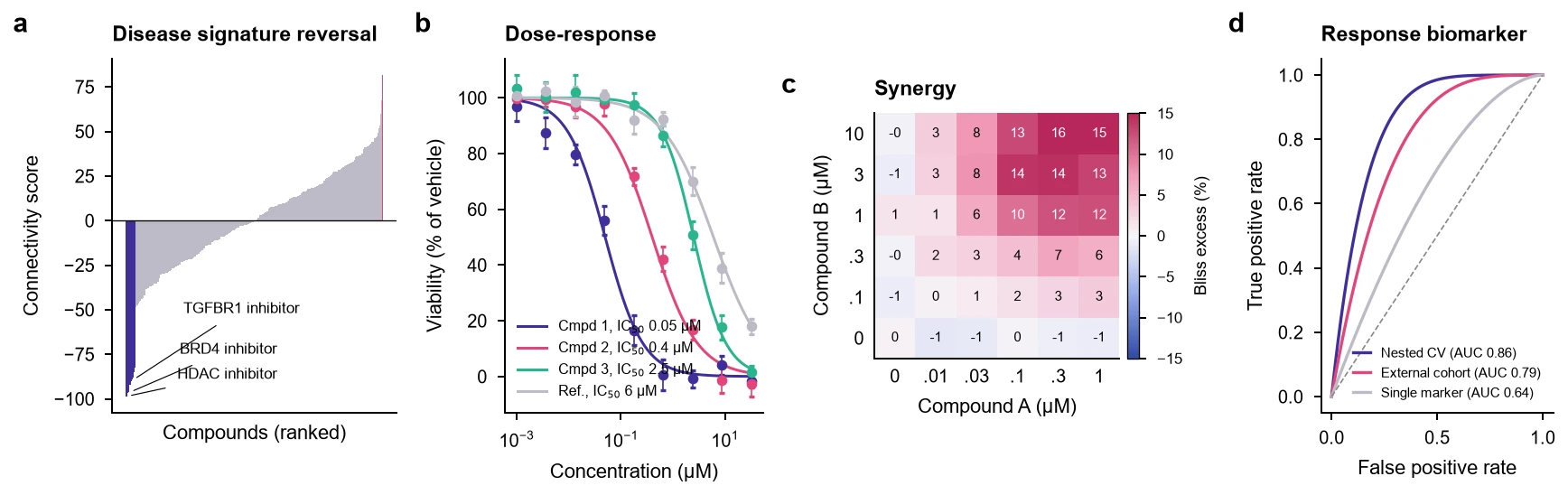
The kind of multi-panel figure we deliver, styled to journal specifications and revised until it is right.
Drug discovery and repurposing: analyses we run
Every analysis below is available from raw data or from your processed files. Pick the ones your question needs; we recommend a robust core set during scoping.
Mechanism of action
- Transcriptomic MoA
- Pathway, TF and kinase activity shifts after treatment.
- Connectivity mapping
- Signature matching against CMap/LINCS L1000.
- Morphological MoA
- Cell Painting similarity to reference compounds.
- Single-cell drug response
- Cell-type-specific responses with multiplexed scRNA-seq (sci-Plex, MIX-Seq style).
Repurposing and combinations
- Signature reversal
- Compounds that reverse disease signatures.
- Network-based repurposing
- Drug-target proximity to disease modules.
- Synergy analysis
- Bliss, Loewe and ZIP synergy scoring from dose matrices.
Translational biomarkers
- Response biomarkers
- Baseline and on-treatment predictors with cross-validation.
- Resistance mechanisms
- Clonal and transcriptional programs enriched in non-responders.
- Patient stratification
- Molecular subtyping and enrichment strategies for trials.
- Pharmacodynamic markers
- Target engagement signatures for dose selection.
What you receive
- MoA and pathway reports
- Ranked repurposing or combination candidates
- Validated biomarker models with performance metrics
- Figures and methods
Mistakes our experts avoid
- Confusing toxicity with mechanismAt high doses, many compounds produce generic stress signatures. We profile across doses and filter generic responses.
- Biomarkers that only work in-sampleWe use nested cross-validation and independent cohorts before calling a biomarker.
- Ignoring cell-line contextMoA signatures differ by cell line. We test consistency across contexts.
Tools and methods
We choose methods for your design, benchmark where it matters, and document versions for reproducibility.
- CMap/clue.io
- ChEMBL
- decoupleR
- SynergyFinder
- scikit-learn
- pycytominer
- DESeq2
- limma
How a project runs
Scoping call
Thirty minutes, free. We learn the biology, the design and the deadline.
Capped estimate
A written plan with hours, deliverables and a cap. No surprise invoices.
Secure transfer and QC
Encrypted transfer, then a QC report and a go/no-go call within days.
Analysis with check-ins
Weekly calls with your duo team and interim figures you can steer.
Figures, methods, code
Publication-quality figures, methods text and reproducible code. Revisions are unlimited.
Frequently asked questions
Can you analyze clinical trial samples?
Yes, for exploratory and translational research. We work within your data governance, and we do not produce clinical diagnostic reports.
Further reading
Send us your Drug discovery data question.
Send a few lines about your experiment. A bioinformatician and a biologist will review it and reply with questions or a capped estimate. Analysis starts at $79/hour, and figure customization is unlimited.
- Free 30-minute scoping call
- Capped estimate before any billable work
- You own all data, code, figures and IP
Prefer email? contact@omicsquest.com