Whole genome, exome and variant analysis
Germline, somatic and structural variants called with best-practice pipelines, then annotated and prioritized for the question you are actually asking.
In short
OmicsQuest analyzes whole genome (WGS), whole exome (WES) and targeted panel sequencing for research use. We call germline variants (GATK, DeepVariant), somatic variants from tumor-normal or tumor-only data (Mutect2, Strelka2), copy-number and structural variants, and annotate with VEP, gnomAD and ClinVar. We also run GWAS, eQTL and long-read genome analysis. Rates start at $79/hour. All work is research use only and not for clinical diagnosis.
Publication-quality figures
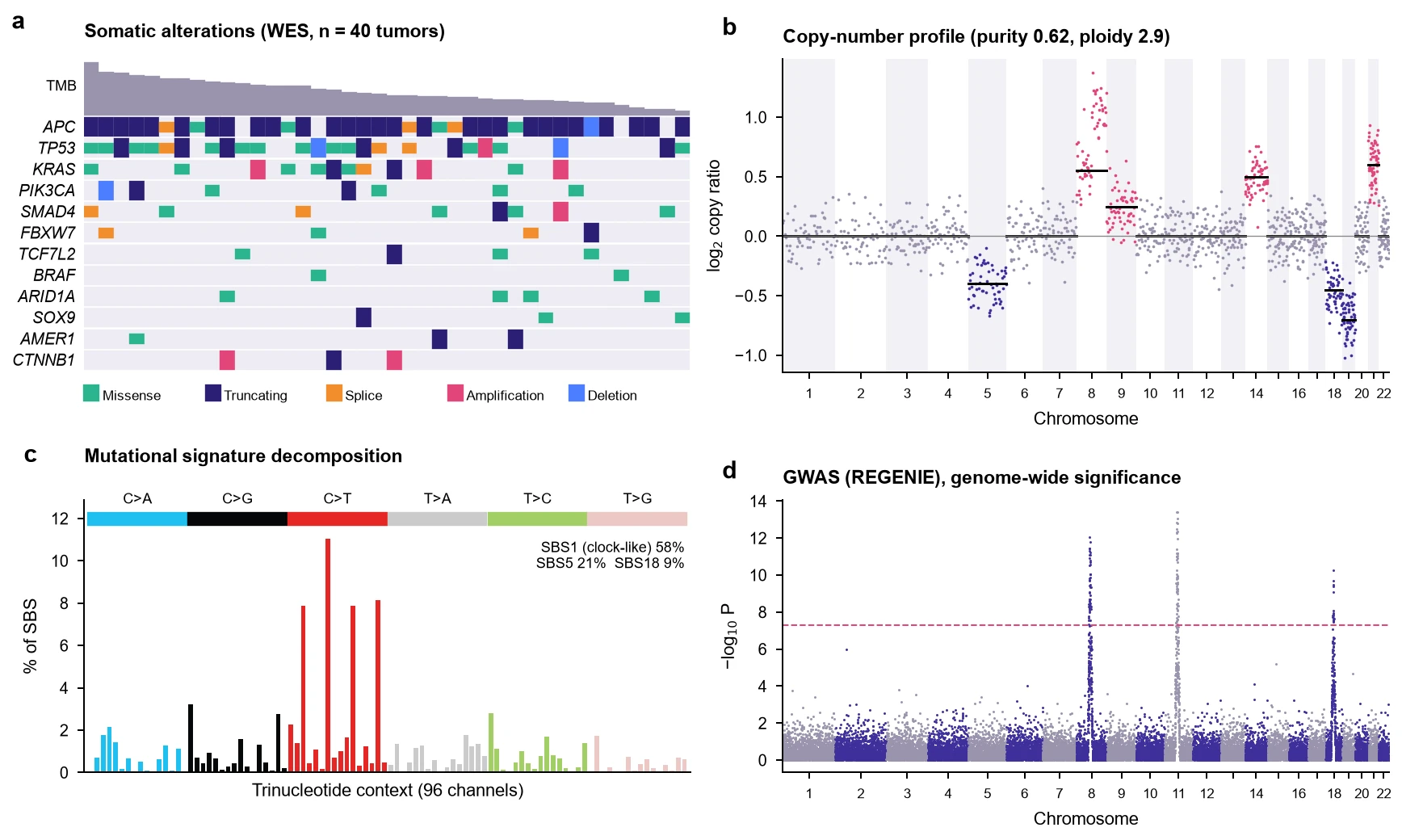
The kind of multi-panel figure we deliver, styled to journal specifications and revised until it is right.
WGS, WES and variant analysis: analyses we run
Every analysis below is available from raw data or from your processed files. Pick the ones your question needs; we recommend a robust core set during scoping.
Variant calling
- Germline small variants
- GATK HaplotypeCaller joint genotyping and DeepVariant/GLnexus.
- Somatic variants
- Mutect2 and Strelka2 with panels of normals and contamination estimation.
- Copy-number variation
- CNVkit, GATK gCNV and FACETS/ASCAT for purity and ploidy.
- Structural variants
- Manta, DELLY and Sniffles2 for long reads.
Annotation and interpretation
- Functional annotation
- VEP/ANNOVAR with gnomAD, ClinVar, CADD, SpliceAI and AlphaMissense.
- Mutational signatures
- SigProfiler and deconstructSigs decomposition.
- Tumor mutational burden and MSI
- TMB and MSIsensor calculations.
- Family and trio analysis
- De novo, compound heterozygous and segregation filtering.
Population and association genetics
- GWAS
- REGENIE/PLINK association, LD clumping and fine-mapping (SuSiE).
- eQTL and colocalization
- QTL mapping and coloc for target genes.
- Ancestry and relatedness
- PCA, admixture and kinship QC.
What you receive
- Alignment and coverage QC
- Annotated, filtered VCFs
- Prioritized variant reports
- Signature, CNV and SV figures
- Methods and code
Mistakes our experts avoid
- No panel of normals for tumor-only callsGermline and artifact calls flood tumor-only data. We use panels of normals and population filters.
- Ignoring tumor purityLow purity hides subclonal variants and distorts CNV. We estimate purity and adjust interpretation.
- Inconsistent reference buildsMixing GRCh37 and GRCh38 resources silently corrupts annotation. We standardize everything.
Tools and methods
We choose methods for your design, benchmark where it matters, and document versions for reproducibility.
- nf-core/sarek
- GATK
- DeepVariant
- Mutect2
- Strelka2
- CNVkit
- Manta
- Sniffles2
- VEP
- SigProfiler
- REGENIE
- SuSiE
How a project runs
Scoping call
Thirty minutes, free. We learn the biology, the design and the deadline.
Capped estimate
A written plan with hours, deliverables and a cap. No surprise invoices.
Secure transfer and QC
Encrypted transfer, then a QC report and a go/no-go call within days.
Analysis with check-ins
Weekly calls with your duo team and interim figures you can steer.
Figures, methods, code
Publication-quality figures, methods text and reproducible code. Revisions are unlimited.
Frequently asked questions
Do you provide clinical variant interpretation?
No. Our genomics services are for research use only. We prioritize and annotate variants for research questions, and we do not issue clinical reports.
Can you analyze long-read genomes?
Yes. We process Oxford Nanopore and PacBio HiFi data for small variants, structural variants, phasing and methylation.
Further reading
Send us your WGS, WES data question.
Send a few lines about your experiment. A bioinformatician and a biologist will review it and reply with questions or a capped estimate. Analysis starts at $79/hour, and figure customization is unlimited.
- Free 30-minute scoping call
- Capped estimate before any billable work
- You own all data, code, figures and IP
Prefer email? contact@omicsquest.com