CRISPR screen and Perturb-seq analysis services
From guide counts to validated hits. We analyze pooled CRISPR knockout, interference and activation screens, and single-cell Perturb-seq, CROP-seq and 10x Feature Barcoding screens.
In short
OmicsQuest analyzes pooled CRISPR knockout, CRISPRi and CRISPRa screens with MAGeCK, BAGEL2 and drugZ, and single-cell perturbation screens (Perturb-seq, CROP-seq, 10x CRISPR Feature Barcoding) with guide assignment, Mixscape, perturbation signatures and gene program analysis. We check library representation, essential-gene recovery and replicate concordance before calling hits. Billing is hourly from $79/hour.
Publication-quality figures
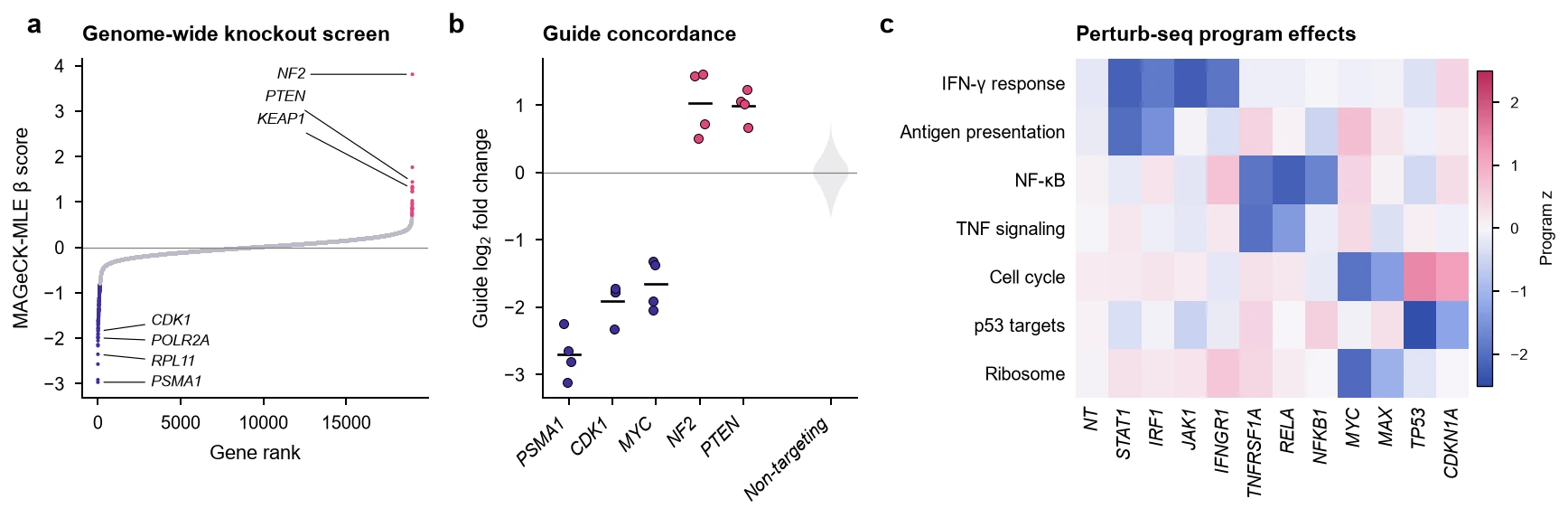
The kind of multi-panel figure we deliver, styled to journal specifications and revised until it is right.
CRISPR screen and Perturb-seq analysis: analyses we run
Every analysis below is available from raw data or from your processed files. Pick the ones your question needs; we recommend a robust core set during scoping.
Pooled screen QC and hit calling
- Guide counting and library QC
- Read mapping to the library, Gini index, zero-count guides and coverage per guide.
- Positive and negative selection
- MAGeCK RRA/MLE, BAGEL2 Bayes factors, drugZ for chemogenetic screens.
- Copy-number correction
- CRISPRcleanR to remove amplicon-driven false essentials.
- Screen performance
- Recovery of core-essential genes (precision-recall) and replicate correlation.
Single-cell perturbation screens
- Guide assignment
- Mixture-model guide calling with multiplet handling and low-MOI checks.
- Perturbation efficacy
- Mixscape to separate perturbed from escaping cells.
- Perturbation signatures
- Pseudobulk DE per perturbation against non-targeting controls.
- Gene program and clustering of perturbations
- Group perturbations by shared transcriptional effects to place genes in pathways.
Follow-up prioritization
- Hit annotation
- Druggability, expression in disease tissue, DepMap dependency and literature context.
- Validation design
- Guide selection and arrayed validation plans.
What you receive
- Screen QC report
- Ranked hit lists with gene- and guide-level statistics
- Perturbation signature tables
- Figures, code and methods
Mistakes our experts avoid
- Calling hits from a bottlenecked screenLow coverage at transduction or harvest produces random dropouts that look like hits. We quantify representation before trusting results.
- Ignoring copy-number artifactsCutting amplified regions kills cells regardless of gene function. We correct for copy number in cancer lines.
- Including non-perturbed cells in Perturb-seqCells that escaped editing dilute the effect. We separate them with Mixscape before testing.
Tools and methods
We choose methods for your design, benchmark where it matters, and document versions for reproducibility.
- MAGeCK
- BAGEL2
- drugZ
- CRISPRcleanR
- Mixscape
- pertpy
- Scanpy
- Seurat
How a project runs
Scoping call
Thirty minutes, free. We learn the biology, the design and the deadline.
Capped estimate
A written plan with hours, deliverables and a cap. No surprise invoices.
Secure transfer and QC
Encrypted transfer, then a QC report and a go/no-go call within days.
Analysis with check-ins
Weekly calls with your duo team and interim figures you can steer.
Figures, methods, code
Publication-quality figures, methods text and reproducible code. Revisions are unlimited.
Frequently asked questions
What coverage do I need for a pooled CRISPR screen?
We recommend at least 500x guide representation at transduction and harvest, and 300-500 reads per guide at sequencing. We can review your design and cell numbers before you start.
Can you analyze a Perturb-seq screen with hundreds of perturbations?
Yes. We have workflows for genome-scale single-cell perturbation data, including efficient guide assignment and perturbation clustering.
Further reading
Send us your CRISPR screen data question.
Send a few lines about your experiment. A bioinformatician and a biologist will review it and reply with questions or a capped estimate. Analysis starts at $79/hour, and figure customization is unlimited.
- Free 30-minute scoping call
- Capped estimate before any billable work
- You own all data, code, figures and IP
Prefer email? contact@omicsquest.com