Multiome and CITE-seq analysis services
When you measure two or three modalities in the same cell, the analysis should use all of them. We run joint modeling for RNA + ATAC, RNA + surface protein, and trimodal assays.
In short
OmicsQuest provides joint analysis of single-cell multi-omic data: 10x Genomics Multiome (gene expression + ATAC), CITE-seq and REAP-seq (RNA + surface protein), TEA-seq and DOGMA-seq. We denoise antibody-derived tags (DSB, totalVI), build weighted-nearest-neighbor or MultiVI joint embeddings, link enhancers to genes and infer regulatory networks with SCENIC+. Rates start at $79/hour and figure revisions are unlimited.
Publication-quality figures
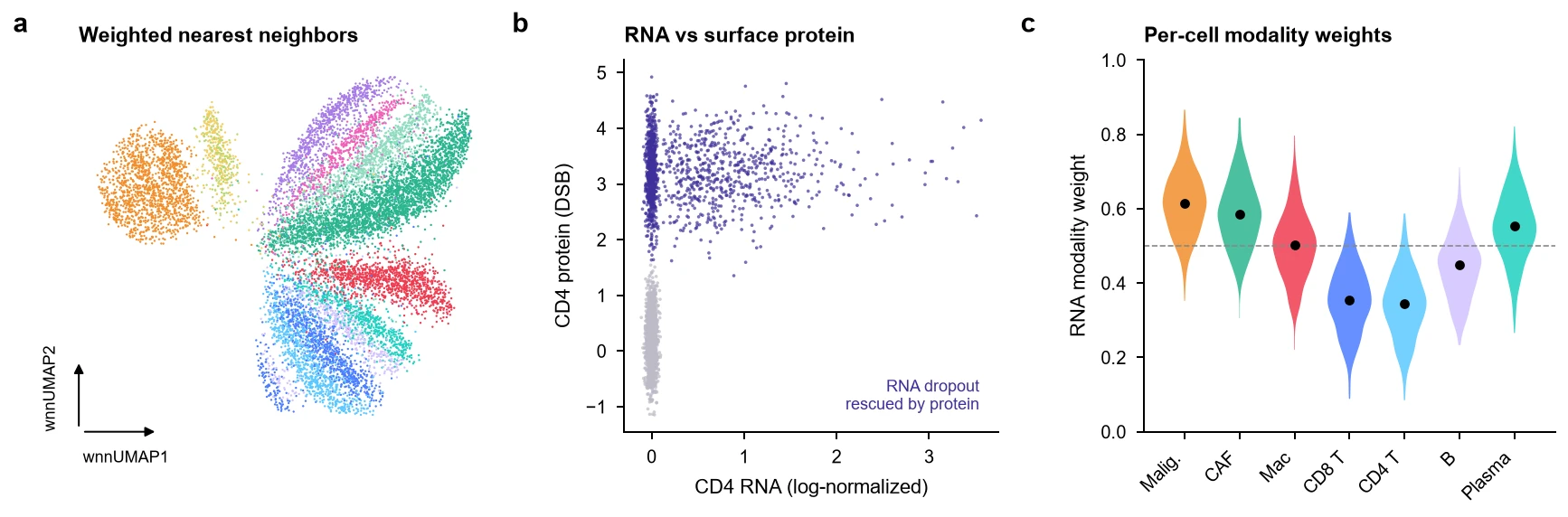
The kind of multi-panel figure we deliver, styled to journal specifications and revised until it is right.
Multiome and CITE-seq analysis: analyses we run
Every analysis below is available from raw data or from your processed files. Pick the ones your question needs; we recommend a robust core set during scoping.
Protein (ADT) processing
- ADT denoising
- DSB normalization using empty droplets and isotype controls, or totalVI background modeling.
- Hashtag demultiplexing
- HTO-based sample assignment and cross-sample doublet removal.
- Gating-style analysis
- Flow-cytometry-like biaxial plots from ADT for immunologist-friendly validation.
Joint representation
- Weighted nearest neighbors (WNN)
- Seurat WNN to weight each modality per cell.
- Deep generative models
- totalVI for RNA + protein and MultiVI for RNA + ATAC, with batch correction.
- Factor analysis
- MOFA+ to find shared and modality-specific variation.
Regulation and interpretation
- Enhancer-gene links
- Peak-to-gene correlation within the same cells.
- Gene regulatory networks
- SCENIC+ eRegulons that connect TF, enhancer and target gene.
- Protein-RNA discordance
- Find cell states where surface protein and transcript disagree, which often matters biologically.
- Multimodal differential testing
- Pseudobulk tests on RNA, accessibility and protein per cell type and condition.
What you receive
- Joint embeddings and annotated MuData/Seurat objects
- ADT QC with denoised protein expression
- Regulatory network tables and figures
- Publication-quality multimodal figures and methods text
Mistakes our experts avoid
- Normalizing ADTs like RNAAntibody counts have high, sample-specific background. We use DSB or totalVI rather than log-normalizing ADTs as if they were transcripts.
- Letting one modality dominateConcatenating features lets ATAC or RNA swamp the other. We weight modalities per cell.
- Over-interpreting peak-gene correlationsCorrelation across cell types is confounded by cell identity. We test links within cell types and against background peaks.
- Missing isotype controlsWithout isotype controls, nonspecific binding looks like real protein expression. We flag it and use empty droplets as background.
Tools and methods
We choose methods for your design, benchmark where it matters, and document versions for reproducibility.
- Seurat WNN
- totalVI
- MultiVI
- MOFA+
- muon
- DSB
- SCENIC+
- Signac
- ArchR
How a project runs
Scoping call
Thirty minutes, free. We learn the biology, the design and the deadline.
Capped estimate
A written plan with hours, deliverables and a cap. No surprise invoices.
Secure transfer and QC
Encrypted transfer, then a QC report and a go/no-go call within days.
Analysis with check-ins
Weekly calls with your duo team and interim figures you can steer.
Figures, methods, code
Publication-quality figures, methods text and reproducible code. Revisions are unlimited.
Frequently asked questions
Is 10x Multiome better than separate scRNA-seq and scATAC-seq?
Multiome measures RNA and ATAC in the same nucleus, so enhancer-gene links and regulatory networks rest on direct pairing instead of inference. The trade-off is lower per-modality depth than single-modality assays. We can help you decide during a free scoping call.
How many antibodies can you handle in CITE-seq?
Panels from 10 to more than 200 antibodies, including TotalSeq-A, -B and -C panels. Larger panels benefit most from totalVI modeling.
Can you combine Multiome with spatial data?
Yes. We often use Multiome-derived cell states and regulatory programs as references for Visium HD or Xenium mapping.
Further reading
Send us your Multiome data question.
Send a few lines about your experiment. A bioinformatician and a biologist will review it and reply with questions or a capped estimate. Analysis starts at $79/hour, and figure customization is unlimited.
- Free 30-minute scoping call
- Capped estimate before any billable work
- You own all data, code, figures and IP
Prefer email? contact@omicsquest.com