Proteomics and phosphoproteomics data analysis
Label-free, TMT and DIA proteomics, phosphoproteomics and affinity proteomics, with honest handling of missing values and normalization.
In short
OmicsQuest analyzes mass spectrometry proteomics (DDA, DIA, TMT/TMTpro, label-free), phosphoproteomics and other PTMs, and affinity proteomics (Olink, SomaScan). We search raw files with DIA-NN, FragPipe or MaxQuant, normalize with care, handle missing values by mechanism, test differential abundance with limma or MSstats, and infer kinase and pathway activity. Pricing starts at $79/hour.
Publication-quality figures
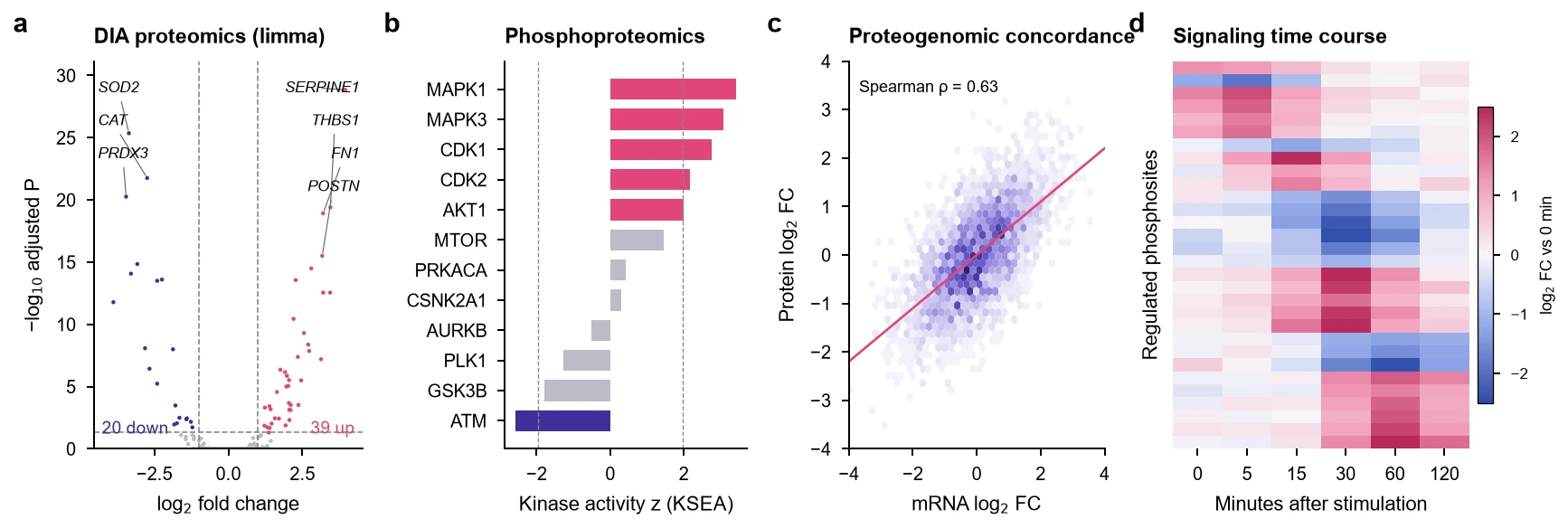
The kind of multi-panel figure we deliver, styled to journal specifications and revised until it is right.
Proteomics and phosphoproteomics: analyses we run
Every analysis below is available from raw data or from your processed files. Pick the ones your question needs; we recommend a robust core set during scoping.
Search and quantification
- Database search
- DIA-NN, FragPipe/MSFragger, MaxQuant or Spectronaut report processing.
- FDR control
- Precursor, peptide and protein-level FDR with protein inference.
- TMT batch bridging
- Reference-channel normalization across plexes (IRS).
Statistics
- Normalization
- Median, VSN or quantile, chosen from diagnostics rather than habit.
- Missing value handling
- Separate missing-at-random from missing-not-at-random; impute only where justified.
- Differential abundance
- limma, MSstats and DEqMS with peptide-count-aware variance.
PTMs and signaling
- Phosphosite localization
- Site localization probabilities and class I site filtering.
- Kinase activity inference
- KSEA, PhosR and decoupleR with curated kinase-substrate sets.
- Protein-level correction
- Separate site changes from protein abundance changes.
Affinity proteomics and integration
- Olink and SomaScan
- NPX/RFU QC, bridging, plate effects and biomarker analysis.
- Proteogenomic integration
- Protein-transcript concordance and multi-omics factor analysis.
- Biomarker panels
- Cross-validated classifiers with nested model selection.
What you receive
- Search and quantification QC
- Protein and PTM site tables
- DE and kinase activity results
- Figures and methods
Mistakes our experts avoid
- Imputing everything the same wayProteins missing because they are below detection are not missing at random. We use mechanism-aware imputation and report sensitivity.
- Ignoring protein changes in phospho dataA phosphosite can rise only because its protein rose. We correct for protein abundance.
- Biomarker overfittingSelecting features on the whole cohort, then cross-validating, leaks information. We use nested validation.
Tools and methods
We choose methods for your design, benchmark where it matters, and document versions for reproducibility.
- DIA-NN
- FragPipe
- MaxQuant
- Spectronaut
- MSstats
- limma
- DEqMS
- PhosR
- KSEA
- OlinkAnalyze
How a project runs
Scoping call
Thirty minutes, free. We learn the biology, the design and the deadline.
Capped estimate
A written plan with hours, deliverables and a cap. No surprise invoices.
Secure transfer and QC
Encrypted transfer, then a QC report and a go/no-go call within days.
Analysis with check-ins
Weekly calls with your duo team and interim figures you can steer.
Figures, methods, code
Publication-quality figures, methods text and reproducible code. Revisions are unlimited.
Frequently asked questions
Can you start from raw mass spec files?
Yes. We search Thermo and Bruker raw files ourselves, which lets us choose libraries, FDR settings and match-between-runs carefully.
Further reading
Send us your Proteomics data question.
Send a few lines about your experiment. A bioinformatician and a biologist will review it and reply with questions or a capped estimate. Analysis starts at $79/hour, and figure customization is unlimited.
- Free 30-minute scoping call
- Capped estimate before any billable work
- You own all data, code, figures and IP
Prefer email? contact@omicsquest.com