Protein-protein interaction analysis services
Separate true interactors from sticky background, then place them in networks and structures that explain function.
In short
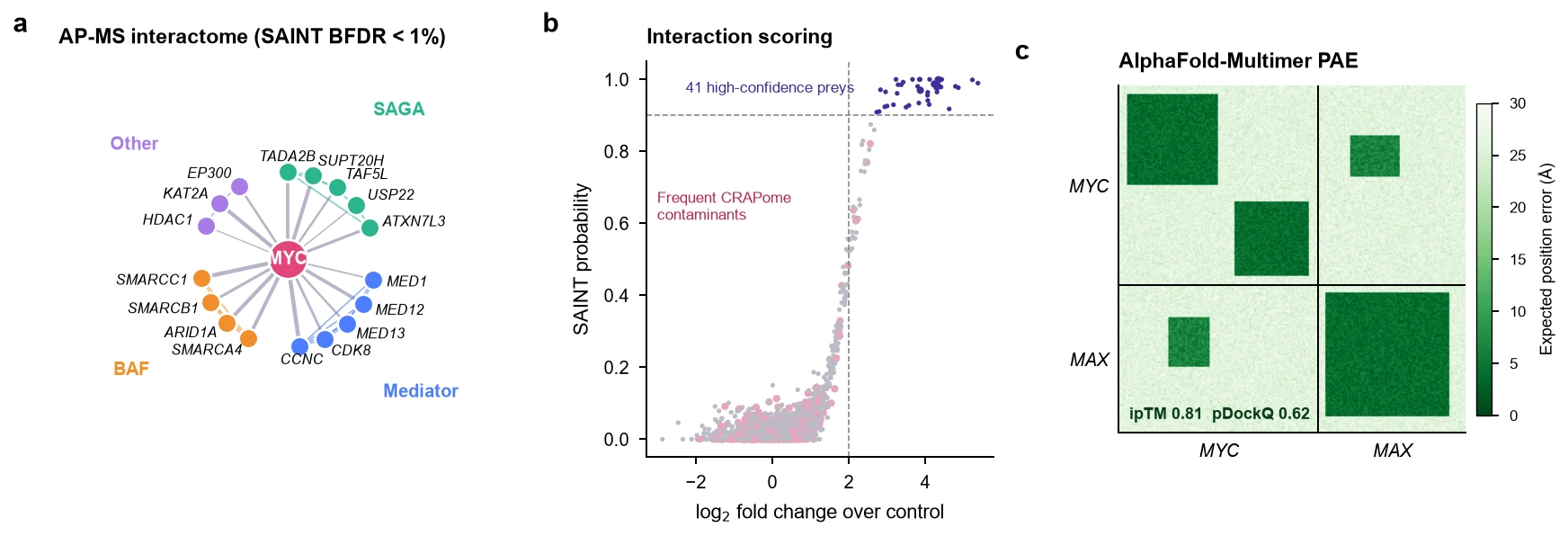
OmicsQuest analyzes protein-protein interaction data from affinity purification mass spectrometry (AP-MS), proximity labeling (BioID, TurboID, APEX), co-IP, yeast two-hybrid and cross-linking MS. We score interactions against controls with SAINTexpress and the CRAPome, build and cluster interaction networks, integrate STRING, BioGRID and IntAct, and model complexes with AlphaFold-Multimer. Pricing starts at $79/hour.
Publication-quality figures
The kind of multi-panel figure we deliver, styled to journal specifications and revised until it is right.
Protein-protein interaction (PPI) analysis: analyses we run
Every analysis below is available from raw data or from your processed files. Pick the ones your question needs; we recommend a robust core set during scoping.
Interaction scoring
- Probabilistic scoring
- SAINTexpress and MiST scoring against matched controls.
- Background filtering
- CRAPome contaminant frequencies and fold change over control.
- Quantitative interactomics
- Label-free and TMT differential interaction across conditions.
Network analysis
- Network construction
- Integrate experimental hits with STRING, BioGRID and IntAct.
- Complex and module detection
- MCL and ClusterONE clustering with CORUM complex enrichment.
- Network propagation
- Prioritize disease or screen hits by network proximity.
Structural modeling
- AlphaFold-Multimer and AlphaFold 3
- Model binary interactions and score interfaces (ipTM, pDockQ).
- Interface and mutation mapping
- Map variants and PTMs to predicted interfaces.
What you receive
- Scored interaction tables
- Cytoscape-ready networks
- Structural models and interface reports
- Figures and methods
Mistakes our experts avoid
- Calling every enriched protein an interactorRibosomal proteins, chaperones and keratins show up in nearly every pull-down. We score against controls and background repositories.
- Ignoring proximity-labeling radiusBioID labels neighbors within roughly 10 nm, not only direct binders. We interpret proximity data accordingly.
- Over-trusting predicted structuresLow-confidence interfaces are hypotheses. We report confidence metrics and recommend validation.
Tools and methods
We choose methods for your design, benchmark where it matters, and document versions for reproducibility.
- SAINTexpress
- CRAPome
- STRING
- BioGRID
- Cytoscape
- AlphaFold-Multimer
- ColabFold
- ClusterONE
How a project runs
Scoping call
Thirty minutes, free. We learn the biology, the design and the deadline.
Capped estimate
A written plan with hours, deliverables and a cap. No surprise invoices.
Secure transfer and QC
Encrypted transfer, then a QC report and a go/no-go call within days.
Analysis with check-ins
Weekly calls with your duo team and interim figures you can steer.
Figures, methods, code
Publication-quality figures, methods text and reproducible code. Revisions are unlimited.
Frequently asked questions
How many controls do I need for AP-MS?
We recommend at least three replicate controls (empty vector, GFP or IgG) processed in parallel. SAINT scoring relies on them.
Further reading
Send us your Protein-protein interaction (PPI) data question.
Send a few lines about your experiment. A bioinformatician and a biologist will review it and reply with questions or a capped estimate. Analysis starts at $79/hour, and figure customization is unlimited.
- Free 30-minute scoping call
- Capped estimate before any billable work
- You own all data, code, figures and IP
Prefer email? contact@omicsquest.com