Bulk RNA-seq data analysis services
Differential expression done properly: experimental design checked first, batch effects handled honestly, and results translated into biology your reviewers will accept.
In short
OmicsQuest analyzes bulk RNA-seq data (mRNA, total RNA, 3' tag-seq, small RNA and long-read) from FASTQ to publication figures. We run read QC, alignment or pseudoalignment (STAR, Salmon), design-aware differential expression (DESeq2, edgeR, limma-voom), batch and confounder assessment, gene set enrichment, transcript isoform and alternative splicing analysis, and cell-type deconvolution. Rates start at $79/hour and figure revisions are unlimited.
Publication-quality figures
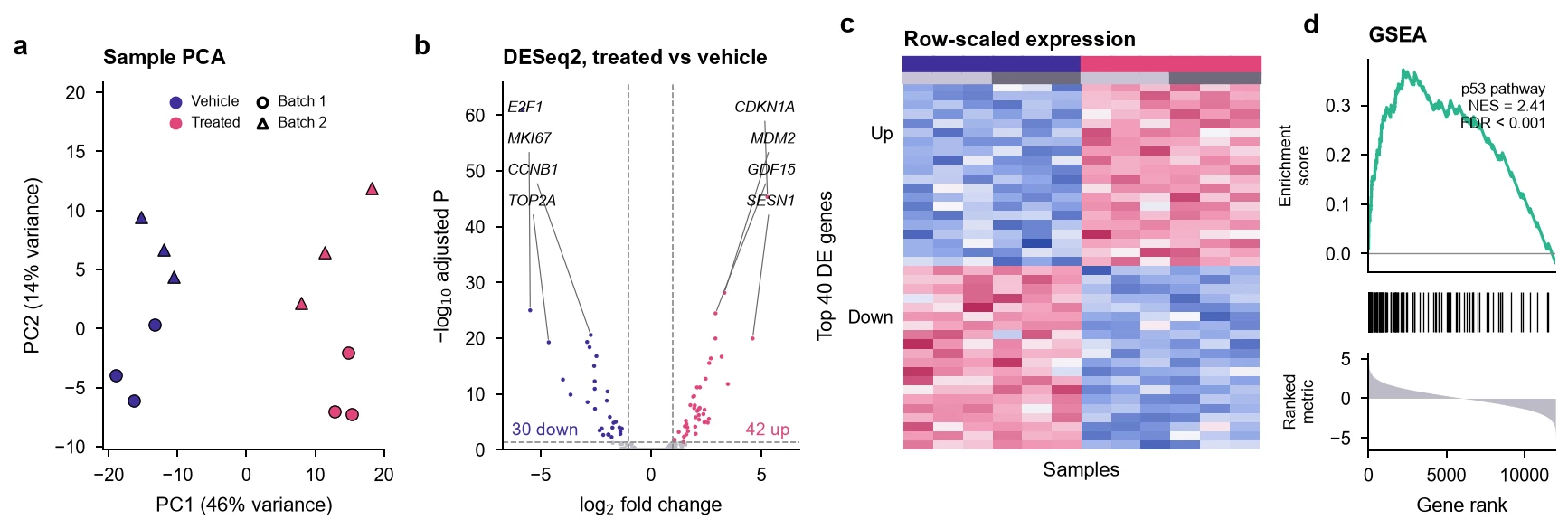
The kind of multi-panel figure we deliver, styled to journal specifications and revised until it is right.
Bulk RNA-seq analysis: analyses we run
Every analysis below is available from raw data or from your processed files. Pick the ones your question needs; we recommend a robust core set during scoping.
Processing and QC
- Read QC and trimming
- FastQC, MultiQC, fastp; adapter, rRNA and contamination checks.
- Alignment and quantification
- STAR + featureCounts or Salmon with tximport, following the nf-core/rnaseq standard.
- Sample-level QC
- Library complexity, gene body coverage, strandedness, sex checks and sample swaps.
- Outlier and confounder assessment
- PCA, sample correlation and variance partitioning on all metadata.
Differential expression
- Design-aware DE
- DESeq2, edgeR or limma-voom with paired, blocked, interaction and multi-factor designs.
- Effect size shrinkage
- apeglm/ashr shrinkage so rankings are not driven by noisy low-count genes.
- Batch handling
- Batch in the design matrix, RUVSeq or SVA for unwanted variation; ComBat-seq only when appropriate.
- Time-course and dose-response
- Likelihood-ratio tests, splines and clustering of temporal profiles.
Interpretation
- Gene set enrichment
- GSEA and fgsea on ranked lists, plus over-representation with the correct background.
- Pathway and TF activity
- PROGENy, decoupleR/DoRothEA, and upstream regulator analysis.
- Co-expression networks
- WGCNA modules linked to traits.
- Cell-type deconvolution
- CIBERSORTx, MuSiC, BayesPrism with single-cell references.
Transcript-level analysis
- Isoform quantification and DTU
- Salmon + DRIMSeq/DEXSeq differential transcript usage.
- Alternative splicing
- rMATS, LeafCutter and MAJIQ.
- Long-read isoforms
- IsoQuant, FLAIR and SQANTI3 for Nanopore and PacBio.
- Fusion and variant detection
- STAR-Fusion, Arriba, and RNA-based variant calling.
- Small RNA and miRNA
- miRDeep2, miRNA DE and target enrichment.
What you receive
- MultiQC and sample QC report
- DE tables with shrunken fold changes and annotations
- Volcano, MA, heatmap, PCA and enrichment figures
- Interactive HTML report
- Code and methods text
Mistakes our experts avoid
- Batch perfectly confounded with conditionIf every treated sample was sequenced on one run and every control on another, no algorithm can separate them. We check this first and tell you what is recoverable.
- Feeding batch-corrected counts to DESeq2Corrected values break the count model. We model batch in the design instead.
- Wrong background for enrichmentUsing the whole genome instead of expressed genes inflates enrichment. We use the correct universe.
- Ranking by p-value aloneTiny fold changes with tiny p-values are rarely biology. We report shrunken effect sizes and set thresholds that mean something.
- Undetected sample swapsSex genes, genotype and known markers catch mislabeled samples. We check before analysis.
Tools and methods
We choose methods for your design, benchmark where it matters, and document versions for reproducibility.
- nf-core/rnaseq
- STAR
- Salmon
- featureCounts
- DESeq2
- edgeR
- limma-voom
- RUVSeq
- sva
- fgsea
- clusterProfiler
- WGCNA
- rMATS
- IsoQuant
How a project runs
Scoping call
Thirty minutes, free. We learn the biology, the design and the deadline.
Capped estimate
A written plan with hours, deliverables and a cap. No surprise invoices.
Secure transfer and QC
Encrypted transfer, then a QC report and a go/no-go call within days.
Analysis with check-ins
Weekly calls with your duo team and interim figures you can steer.
Figures, methods, code
Publication-quality figures, methods text and reproducible code. Revisions are unlimited.
Projects we rescued
Frequently asked questions
How much does RNA-seq data analysis cost?
Bulk RNA-seq analysis is billed from $79/hour. A standard project (QC, alignment, DE across a few contrasts, enrichment and figures) usually takes 8-20 hours. Complex designs, time courses or splicing analysis take longer. You always get a capped estimate first.
DESeq2, edgeR or limma: which do you use?
All three are sound when used correctly. We pick based on design, sample size and data type: limma-voom for complex designs and large cohorts, DESeq2 or edgeR for typical experiments. We sometimes run more than one as a robustness check.
Can you analyze RNA-seq from public datasets (GEO, SRA, TCGA)?
Yes. We download, reprocess and harmonize public data, including TCGA, GTEx and GEO series, to validate your findings or build meta-analyses.
How many replicates do I need for RNA-seq?
At least three biological replicates per group. Four to six is better for detecting moderate fold changes. We can run a power analysis from pilot data.
Further reading
Send us your Bulk RNA-seq data question.
Send a few lines about your experiment. A bioinformatician and a biologist will review it and reply with questions or a capped estimate. Analysis starts at $79/hour, and figure customization is unlimited.
- Free 30-minute scoping call
- Capped estimate before any billable work
- You own all data, code, figures and IP
Prefer email? contact@omicsquest.com