TCR and BCR immune repertoire analysis services
Connect clonotypes to cell states. We combine 10x VDJ, AIRR-seq and gene expression to show which clones expand, where they go and what they are doing.
In short
OmicsQuest analyzes single-cell (10x 5' VDJ) and bulk (AIRR-seq) T-cell and B-cell receptor repertoires. We call clonotypes, quantify clonal expansion and diversity, track clones across tissues and time points, build B-cell lineage trees with somatic hypermutation, predict antigen specificity against public databases, and link each clone to its transcriptional state. Billing is hourly from $79/hour.
Publication-quality figures
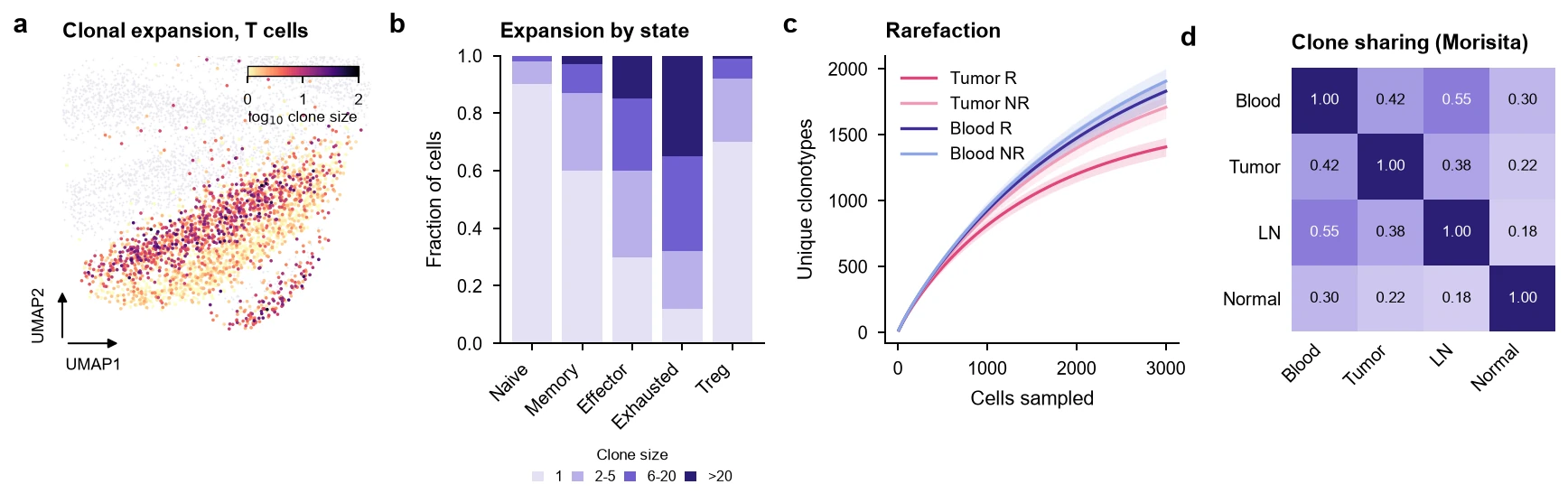
The kind of multi-panel figure we deliver, styled to journal specifications and revised until it is right.
TCR/BCR immune repertoire analysis: analyses we run
Every analysis below is available from raw data or from your processed files. Pick the ones your question needs; we recommend a robust core set during scoping.
Clonotype definition
- Clonotype calling
- Paired-chain clonotypes with handling of dual-alpha and orphan chains.
- B-cell clonal families
- Change-O / SCOPer clustering on CDR3 similarity and V/J usage.
Repertoire statistics
- Clonal expansion and diversity
- Shannon, Simpson, Gini and Hill-number diversity profiles with rarefaction.
- V(D)J gene usage
- Usage biases and pairing preferences between conditions.
- Clone tracking
- Shared clones across tissues, blood and time points.
Specificity and evolution
- Antigen specificity prediction
- Matching to VDJdb, McPAS-TCR and IEDB, plus GLIPH2 and TCRdist3 specificity groups.
- Somatic hypermutation and lineage trees
- IgPhyML / dowser phylogenies for B-cell affinity maturation.
- Isotype class switching
- Isotype distributions per clone and cell state.
Integration with gene expression
- Clone-to-state mapping
- Where expanded clones sit on the UMAP: effector, exhausted, memory or tissue-resident.
- Clonal state transitions
- Shared clones across states as evidence for differentiation paths.
What you receive
- Clonotype and diversity tables
- Clone-tracking and lineage figures
- Integrated VDJ + GEX objects
- Methods text and code
Mistakes our experts avoid
- Comparing diversity at unequal depthDiversity indices depend strongly on the number of cells sampled. We rarefy or use coverage-based estimates.
- Treating every barcode as a cloneAmbient VDJ transcripts and doublets create spurious shared clones. We filter chains by UMI support and doublet status.
- Over-trusting database matchesPublic specificity databases are biased toward viral epitopes. We present matches as hypotheses with confidence levels.
Tools and methods
We choose methods for your design, benchmark where it matters, and document versions for reproducibility.
- scirpy
- scRepertoire
- Immcantation
- Change-O
- dowser
- MiXCR
- TCRdist3
- GLIPH2
- VDJdb
How a project runs
Scoping call
Thirty minutes, free. We learn the biology, the design and the deadline.
Capped estimate
A written plan with hours, deliverables and a cap. No surprise invoices.
Secure transfer and QC
Encrypted transfer, then a QC report and a go/no-go call within days.
Analysis with check-ins
Weekly calls with your duo team and interim figures you can steer.
Figures, methods, code
Publication-quality figures, methods text and reproducible code. Revisions are unlimited.
Frequently asked questions
Can you link TCR clonotypes to gene expression?
Yes. This is the main value of single-cell VDJ: we show which transcriptional states expanded clones occupy and whether clones are shared across states, tissues or time points.
Do you analyze bulk AIRR-seq?
Yes. We process bulk TCR/BCR sequencing with MiXCR or the Immcantation suite and apply the same diversity and clone-tracking statistics.
Further reading
Send us your TCR/BCR immune repertoire data question.
Send a few lines about your experiment. A bioinformatician and a biologist will review it and reply with questions or a capped estimate. Analysis starts at $79/hour, and figure customization is unlimited.
- Free 30-minute scoping call
- Capped estimate before any billable work
- You own all data, code, figures and IP
Prefer email? contact@omicsquest.com