Spatial omics analysis: CosMx, MERSCOPE, GeoMx, Stereo-seq and CODEX
Platform-agnostic spatial analysis for imaging- and sequencing-based transcriptomics and multiplexed protein imaging, built on the open SpatialData standard.
In short
Beyond Visium HD and Xenium, OmicsQuest analyzes NanoString/Bruker CosMx SMI, Vizgen MERSCOPE (MERFISH), GeoMx DSP, BGI Stereo-seq, Slide-seq, Curio Seeker, and multiplexed protein imaging (Akoya PhenoCycler/CODEX, imaging mass cytometry, MIBI, COMET). Every project uses the same SpatialData-based framework: segmentation, phenotyping, neighborhoods, niches and replicate-aware statistics. Pricing starts at $79/hour.
Publication-quality figures
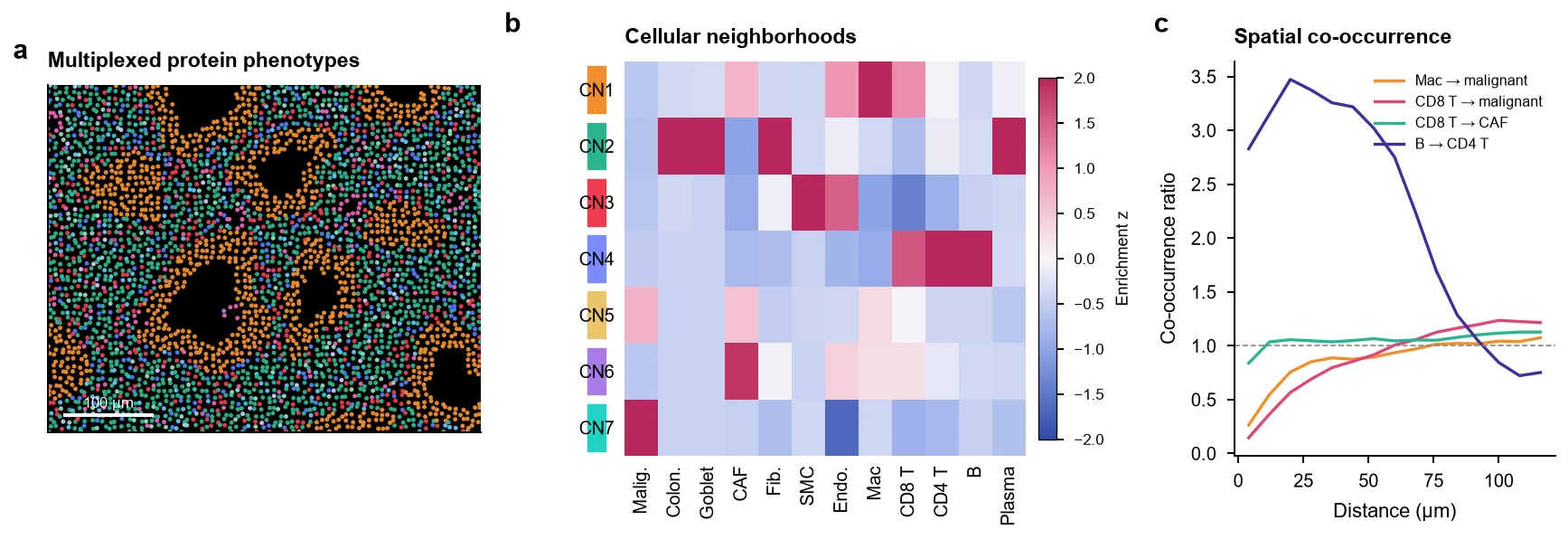
The kind of multi-panel figure we deliver, styled to journal specifications and revised until it is right.
Spatial omics (CosMx, MERSCOPE, GeoMx, CODEX): analyses we run
Every analysis below is available from raw data or from your processed files. Pick the ones your question needs; we recommend a robust core set during scoping.
Imaging-based transcriptomics (CosMx, MERSCOPE)
- FOV and transcript QC
- Field-of-view quality, negative probes and detection efficiency.
- Segmentation and re-segmentation
- Cellpose, Baysor and Proseg with membrane and nuclear stains.
- Annotation and niches
- Reference mapping, cellular neighborhoods and niche composition.
Region-based profiling (GeoMx DSP)
- ROI/AOI QC and normalization
- Q3 and background normalization with negative probe modeling.
- Differential expression between compartments
- Mixed models with patient as a random effect.
- Deconvolution
- SpatialDecon cell abundance estimates per AOI.
Sequencing-based spatial (Stereo-seq, Slide-seq)
- Bin and cell-bin analysis
- Resolution selection and cell-bin segmentation.
- Spatial domains and SVGs
- Domain detection and spatially variable gene analysis.
Multiplexed protein imaging (CODEX, IMC, MIBI)
- Image preprocessing
- Channel QC, background subtraction, spillover compensation (IMC).
- Segmentation and phenotyping
- Mesmer/Cellpose segmentation, then clustering and gating-based phenotyping.
- Spatial statistics
- Neighborhood analysis, Ripley's K, cellular neighborhoods and interaction tests.
What you receive
- QC report per platform
- Annotated SpatialData objects
- Phenotype and niche maps
- Publication figures and methods
Mistakes our experts avoid
- Platform-specific QC skippedEach technology fails differently, from FOV dropouts in CosMx to probe saturation in GeoMx. We apply the right QC for each.
- Comparing ROIs as independent patientsMultiple ROIs from one patient are not independent. We use mixed models.
- Phenotyping without spillover controlSignal bleed between channels or neighboring cells creates double-positive artifacts. We compensate and verify.
Tools and methods
We choose methods for your design, benchmark where it matters, and document versions for reproducibility.
- SpatialData
- Squidpy
- Giotto
- Seurat
- Cellpose
- Mesmer
- Baysor
- GeomxTools
- SpatialDecon
- steinbock
- scimap
How a project runs
Scoping call
Thirty minutes, free. We learn the biology, the design and the deadline.
Capped estimate
A written plan with hours, deliverables and a cap. No surprise invoices.
Secure transfer and QC
Encrypted transfer, then a QC report and a go/no-go call within days.
Analysis with check-ins
Weekly calls with your duo team and interim figures you can steer.
Figures, methods, code
Publication-quality figures, methods text and reproducible code. Revisions are unlimited.
Frequently asked questions
Can you combine data from different spatial platforms?
Yes. We integrate serial sections across platforms (for example, Visium HD for discovery with CosMx or Xenium for single-cell validation) in a common coordinate framework.
Do you analyze multiplexed immunofluorescence?
Yes, including PhenoCycler/CODEX, COMET, cyclic IF and imaging mass cytometry, from raw images to phenotypes and spatial statistics.
Further reading
Send us your Spatial omics (CosMx, MERSCOPE, GeoMx, CODEX) data question.
Send a few lines about your experiment. A bioinformatician and a biologist will review it and reply with questions or a capped estimate. Analysis starts at $79/hour, and figure customization is unlimited.
- Free 30-minute scoping call
- Capped estimate before any billable work
- You own all data, code, figures and IP
Prefer email? contact@omicsquest.com