ChIP-seq, CUT&RUN, CUT&Tag and ATAC-seq analysis
Peaks, differential binding and the transcription factors behind them, with the controls and normalization that epigenomics reviewers check first.
In short
OmicsQuest analyzes bulk chromatin data: ChIP-seq (TF and histone), CUT&RUN, CUT&Tag, ATAC-seq, DNase-seq and DNA methylation (WGBS, EM-seq, RRBS, arrays). We follow ENCODE-style QC, call peaks with the right model for narrow or broad marks, use spike-in normalization where appropriate, test differential binding with DiffBind or csaw, and integrate with RNA-seq to connect chromatin changes with expression. Pricing starts at $79/hour.
Publication-quality figures
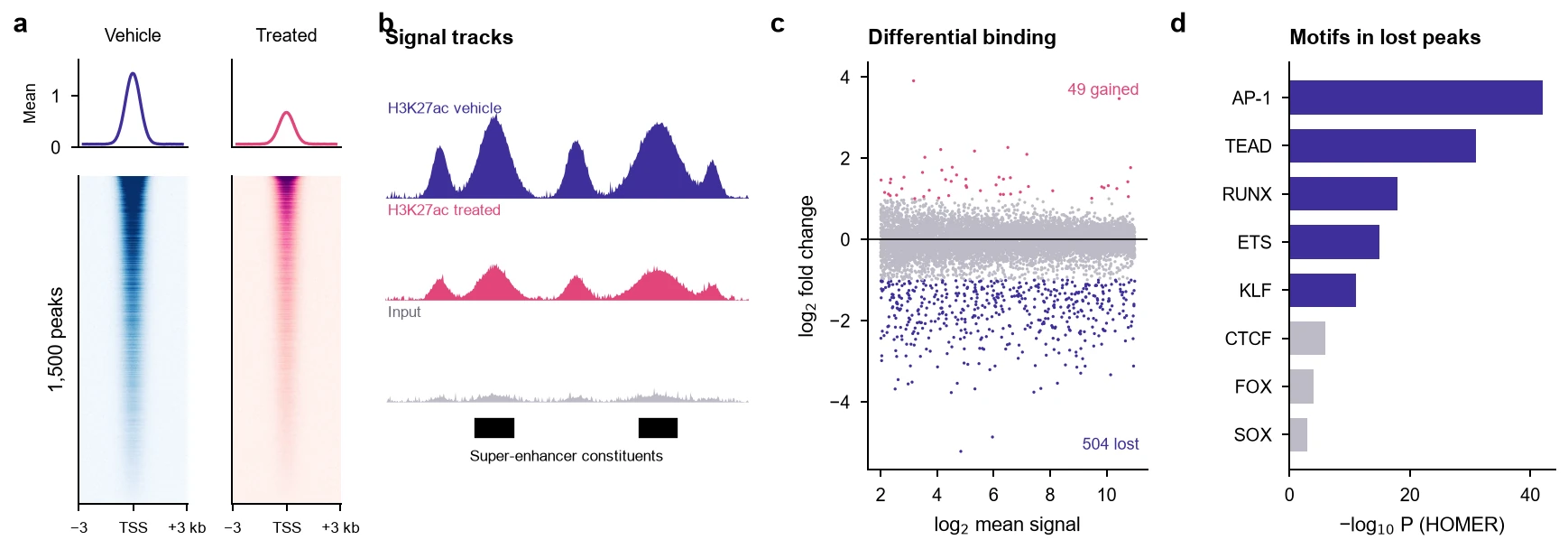
The kind of multi-panel figure we deliver, styled to journal specifications and revised until it is right.
ChIP-seq, CUT&RUN and ATAC-seq: analyses we run
Every analysis below is available from raw data or from your processed files. Pick the ones your question needs; we recommend a robust core set during scoping.
QC and peak calling
- ENCODE-style QC
- FRiP, NSC/RSC, library complexity, IDR for replicate concordance.
- Peak calling
- MACS2/3 narrow and broad modes, SEACR for CUT&RUN/CUT&Tag.
- Spike-in normalization
- Drosophila or E. coli spike-in scaling for global changes (e.g., EZH2 or BET inhibition).
- Blacklist and artifact filtering
- ENCODE blacklist and high-signal region removal.
Differential and functional analysis
- Differential binding/accessibility
- DiffBind, csaw and DESeq2 on consensus peaks.
- Motif analysis
- HOMER and MEME-ChIP de novo and known motif enrichment.
- Super-enhancer calling
- ROSE on H3K27ac.
- Chromatin state segmentation
- ChromHMM across multiple marks.
- Peak annotation and GREAT
- Genomic distribution and regulatory domain enrichment.
DNA methylation
- Bisulfite and EM-seq processing
- Bismark, methylation calling and coverage QC.
- Differentially methylated regions
- DSS, dmrseq and methylKit.
- Array analysis
- minfi/SeSAMe processing of EPIC and 450K arrays, epigenetic clocks.
Integration
- Integration with RNA-seq
- Link differential peaks to differentially expressed genes.
- Hi-C and 3D context
- Overlay with chromatin loops and TADs where available.
What you receive
- QC report with IDR and FRiP
- Peak sets and normalized bigWig tracks
- Differential binding tables
- Motif results and browser figures
- Methods and code
Mistakes our experts avoid
- Missing input or IgG controlWithout controls, open chromatin and sticky regions look like binding. We require or substitute appropriate controls and flag limits.
- Ignoring global changesIf a treatment changes total histone marks, standard normalization hides it. We use spike-ins when the biology calls for it.
- Narrow-peak calling on broad marksH3K27me3 and H3K36me3 need broad-domain methods.
Tools and methods
We choose methods for your design, benchmark where it matters, and document versions for reproducibility.
- nf-core/chipseq
- nf-core/atacseq
- nf-core/cutandrun
- Bowtie2
- MACS3
- SEACR
- DiffBind
- csaw
- HOMER
- deepTools
- ChromHMM
- Bismark
- DSS
- minfi
How a project runs
Scoping call
Thirty minutes, free. We learn the biology, the design and the deadline.
Capped estimate
A written plan with hours, deliverables and a cap. No surprise invoices.
Secure transfer and QC
Encrypted transfer, then a QC report and a go/no-go call within days.
Analysis with check-ins
Weekly calls with your duo team and interim figures you can steer.
Figures, methods, code
Publication-quality figures, methods text and reproducible code. Revisions are unlimited.
Frequently asked questions
CUT&RUN or ChIP-seq: does the analysis differ?
Yes. CUT&RUN and CUT&Tag have low background and often need SEACR or adjusted MACS settings, different duplicate handling and, where needed, E. coli carry-over or spike-in normalization.
Can you integrate ChIP-seq with RNA-seq?
Yes. We link binding or accessibility changes to target genes and test whether chromatin changes explain expression changes.
Further reading
Send us your ChIP-seq, CUT&RUN data question.
Send a few lines about your experiment. A bioinformatician and a biologist will review it and reply with questions or a capped estimate. Analysis starts at $79/hour, and figure customization is unlimited.
- Free 30-minute scoping call
- Capped estimate before any billable work
- You own all data, code, figures and IP
Prefer email? contact@omicsquest.com