Live-cell imaging and cell tracking analysis
Time-lapse microscopy turned into measured behavior: segmentation, tracking with error correction, lineages, migration and dynamics per cell.
In short
OmicsQuest analyzes live-cell and time-lapse microscopy: deep-learning segmentation (Cellpose, StarDist), cell tracking with gap closing and division detection (TrackMate, ultrack, btrack), lineage reconstruction, migration and velocity statistics, cell-cycle timing with FUCCI reporters, single-particle tracking and organoid or embryo dynamics. We validate tracks against manual ground truth. Pricing starts at $79/hour.
Publication-quality figures
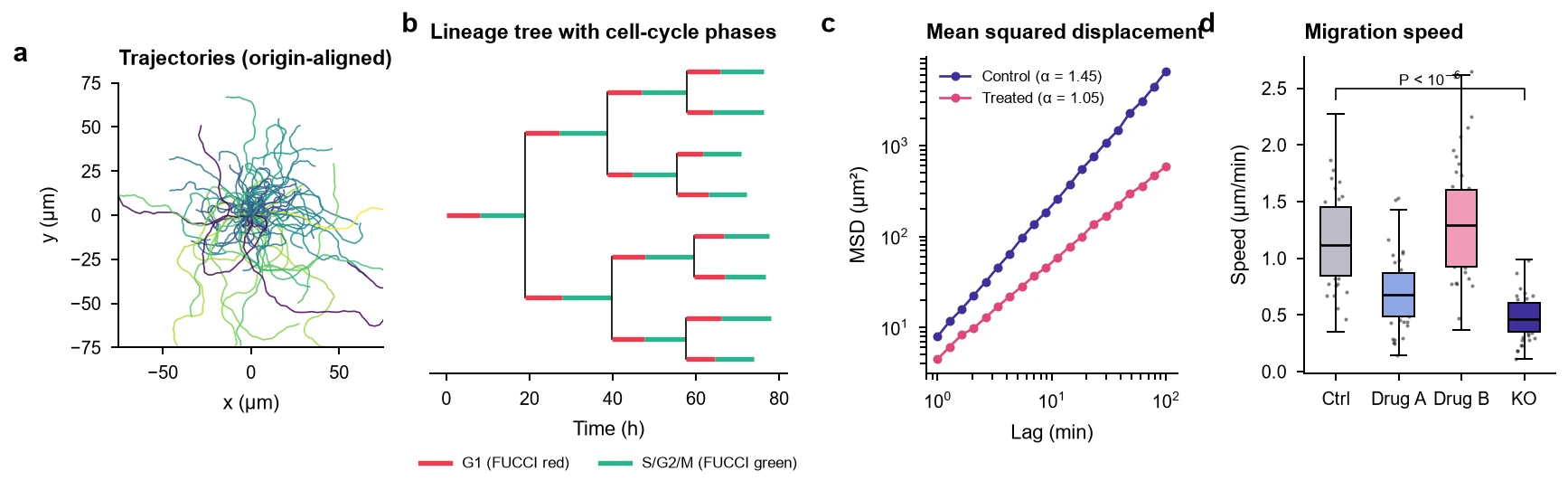
The kind of multi-panel figure we deliver, styled to journal specifications and revised until it is right.
Live-cell imaging and cell tracking: analyses we run
Every analysis below is available from raw data or from your processed files. Pick the ones your question needs; we recommend a robust core set during scoping.
Segmentation
- Deep-learning segmentation
- Cellpose and StarDist, fine-tuned on your images when needed.
- 3D and light-sheet segmentation
- Nuclear and membrane segmentation in 3D stacks.
Tracking
- Multi-object tracking
- TrackMate LAP, ultrack and btrack with gap closing.
- Division and lineage detection
- Mitosis detection and lineage tree reconstruction.
- Track curation
- Error correction in napari with quantified tracking accuracy.
- Single-particle tracking
- Diffusion coefficients and motion-type classification (MSD analysis).
Dynamics and phenotypes
- Migration statistics
- Speed, persistence, directionality and chemotaxis indices.
- Cell-cycle timing
- FUCCI phase durations and division intervals.
- Reporter dynamics
- Single-cell intensity time series, pulsing and oscillation analysis.
- Fate and event detection
- Death, differentiation and morphological transition classification.
What you receive
- Segmentation and tracking QC with accuracy metrics
- Track and lineage tables
- Annotated movies and lineage figures
- Statistics and methods
Mistakes our experts avoid
- Identity swaps in dense fieldsWhen cells touch, trackers swap identities and lineages break silently. We measure swap rates against manual annotation and curate.
- Phototoxicity read as biologyLight exposure slows division and migration. We look for exposure-dependent trends.
- Averaging over heterogeneous behaviorPopulation means hide subpopulations. We analyze single-cell distributions.
Tools and methods
We choose methods for your design, benchmark where it matters, and document versions for reproducibility.
- Cellpose
- StarDist
- TrackMate
- ultrack
- btrack
- napari
- Fiji
- trackpy
- scikit-image
How a project runs
Scoping call
Thirty minutes, free. We learn the biology, the design and the deadline.
Capped estimate
A written plan with hours, deliverables and a cap. No surprise invoices.
Secure transfer and QC
Encrypted transfer, then a QC report and a go/no-go call within days.
Analysis with check-ins
Weekly calls with your duo team and interim figures you can steer.
Figures, methods, code
Publication-quality figures, methods text and reproducible code. Revisions are unlimited.
Projects we rescued
Frequently asked questions
Can you track cells in 3D light-sheet data?
Yes. We segment and track nuclei in 3D time-lapse data, including embryos and organoids, with GPU-accelerated workflows.
How do you know the tracks are correct?
We annotate a subset manually and report tracking accuracy (for example, the fraction of correct links and divisions) before computing statistics.
Further reading
Send us your Live-cell imaging data question.
Send a few lines about your experiment. A bioinformatician and a biologist will review it and reply with questions or a capped estimate. Analysis starts at $79/hour, and figure customization is unlimited.
- Free 30-minute scoping call
- Capped estimate before any billable work
- You own all data, code, figures and IP
Prefer email? contact@omicsquest.com