Target discovery with TargetQuest
Agentic target discovery on the Virtual Human, our substrate of 50 million+ single-cell and spatial profiles. You get evidence-backed, falsification-tested targets and the experiment that best tests each one.
In short
OmicsQuest runs target discovery with TargetQuest, an agentic AI system supervised by our scientists. A coordinating agent breaks your program question into hypotheses. Specialist agents analyze human genetics, single-cell and spatial specificity, regulatory and causal evidence, druggability, safety, modality and the clinical landscape on the Virtual Human, our harmonized substrate of 50 million+ single-cell and spatial profiles, plus your own data. Falsification agents try to break every claim, an evaluator scores what survives, and an experiment-selection agent picks the wet-lab experiments with the highest information gain. Engagements start at $79/hour, with fixed-scope program options.
TargetQuest: agentic target discovery on the Virtual Human
TargetQuest is our target discovery system. Coordinated AI agents analyze the Virtual Human, our harmonized substrate of 50 million+ single-cell and spatial profiles, together with your own data. Human scientists review every step. Each candidate target arrives with the evidence that supports it, the attempts to falsify it, and the experiment that would best test it.
How a TargetQuest cycle runs
Decompose the question
The coordinating agent turns a program question, such as which targets reverse fibrotic remodeling in heart failure, into hypotheses that can be tested.
Run specialist analyses
Eight specialist agents query genetics, single-cell and spatial atlases, regulatory data, causal evidence, chemistry, safety, modality and the clinical landscape. Every result records its data, code and parameters.
Build the target-evidence graph
Findings become nodes and edges linking targets to cell states, niches, variants, pathways and liabilities across the Virtual Human.
Try to falsify every claim
Falsification agents look for the weak points: confounded cohorts, single-dataset effects, reverse causation, expression outside the disease niche. Claims that fail are rejected with the reason recorded.
Score what survives
The evaluator agent scores evidence strength per target with transparent weights your team can change.
Choose the next experiment
The experiment-selection agent ranks candidate wet-lab experiments by expected information gain, so each assay removes the most uncertainty.
Learn from the results
Labeled results from your lab or our partners flow back into the graph, and the agents are benchmarked against held-out outcomes so the system improves with every cycle.
The Virtual Human
50 million+ single-cell and spatial profiles, harmonized into one reference across organs, developmental stages, healthy tissue and disease. Cell states and tissue niches are annotated consistently, so a target's specificity can be compared across the whole body, not just one dataset. Your own data is mapped onto it, and it is never added to the shared substrate without your written permission.
Why falsification comes first
Most target lists fail because nobody tried hard to break them. TargetQuest assigns agents whose only job is to find the reasons a target is wrong. What remains is a shorter list that holds up to the questions your program committee, partners and investors will ask.
Humans stay in charge
An TargetQuest engagement is run by an OmicsQuest bioinformatician and biologist duo team. They set the question, review agent outputs, tune the evidence weights with you and sign off on every recommendation.
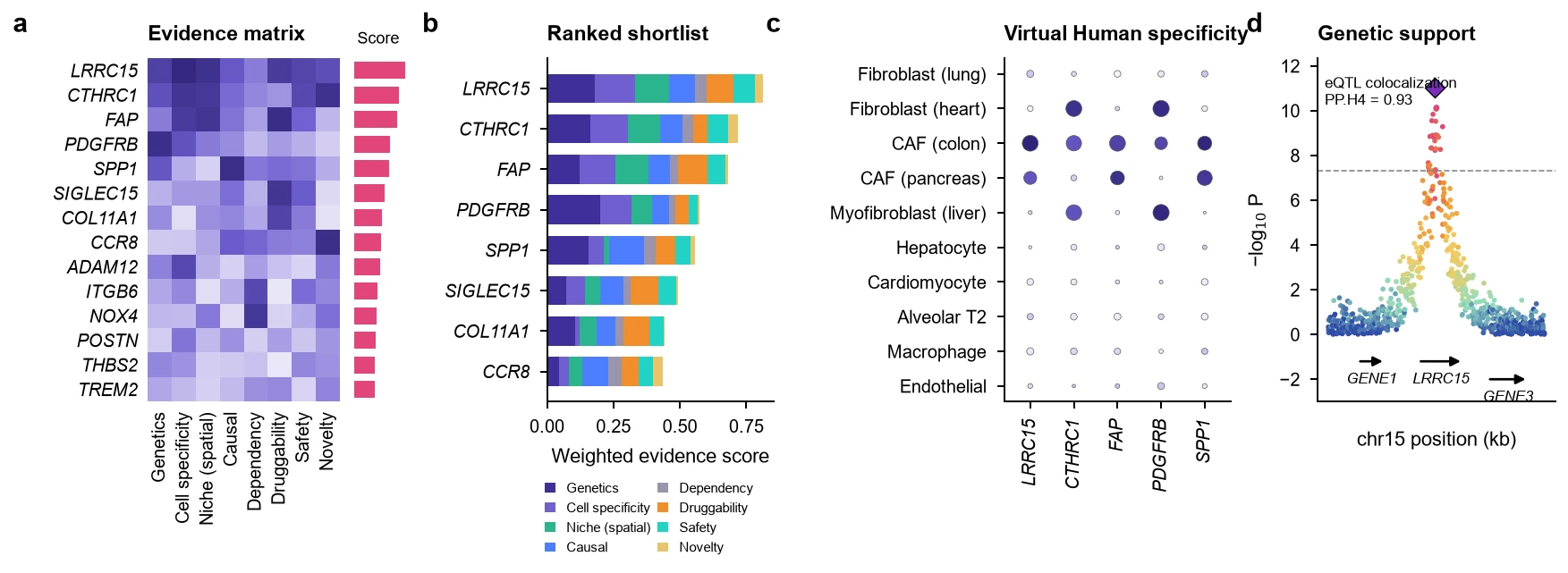
Publication-quality figures
The kind of multi-panel figure we deliver, styled to journal specifications and revised until it is right.
Target discovery (TargetQuest): analyses we run
Every analysis below is available from raw data or from your processed files. Pick the ones your question needs; we recommend a robust core set during scoping.
Agentic workflow (TargetQuest)
- Question decomposition
- A coordinating agent turns the program question into testable hypotheses and assigns them to specialists.
- Virtual Human queries
- Cell-state and niche specificity of each candidate across 50 million+ harmonized single-cell and spatial profiles.
- Provenance-tracked evidence graph
- Every claim links to its dataset, code, parameters and agent, so reviewers can audit it.
- Falsification
- Dedicated agents search for confounding, single-dataset effects, reverse causation and off-niche expression, and reject failed claims.
- Evidence scoring
- Transparent, adjustable weights per evidence stream, reviewed with your team.
- Experiment selection
- Wet-lab experiments ranked by expected information gain, with assay, model and readout recommendations.
- Closed-loop learning
- Your labeled results update the graph and are scored against held-out benchmarks.
Genetic and causal evidence
- GWAS and fine-mapping
- Credible sets, variant-to-gene mapping (L2G) and colocalization with eQTL/pQTL.
- Mendelian randomization
- Causal effect estimates for druggable proteins (pQTL-based MR).
- Rare variant burden
- Gene-level burden evidence from exome cohorts.
Expression and cell-type context
- Disease single-cell specificity
- Which cell types express the target in disease versus healthy tissue.
- Spatial context
- Where target-expressing cells sit in the lesion.
- Tissue safety expression
- GTEx and Human Protein Atlas expression in critical tissues.
Functional evidence
- CRISPR dependency
- DepMap Chronos dependency and selectivity.
- Perturbation phenotypes
- Perturb-seq and CRISPR screen evidence for pathway effects.
- Network proximity
- Distance to disease modules and known drug targets.
Tractability and liabilities
- Druggability
- Pocket prediction, ChEMBL chemistry, antibody accessibility and modality fit.
- Safety assessment
- Knockout phenotypes, essentiality, pharmacovigilance signals and paralogs.
- Competitive landscape
- Clinical trials, patents and pipeline mapping.
What you receive
- Weighted, transparent target ranking
- Per-target evidence dossiers
- Interactive dashboard for team review
- Methods and full provenance
Mistakes our experts avoid
- Ranking by differential expression aloneGenes that change in disease are often consequences, not causes. We weight causal genetic evidence, which is linked to higher clinical success rates.
- Black-box scoresTeams cannot act on a score they cannot interrogate. Every evidence stream and weight is visible and adjustable.
- Ignoring cell-type specificityA target expressed in every cell type carries safety risk. We quantify specificity from single-cell atlases.
Tools and methods
We choose methods for your design, benchmark where it matters, and document versions for reproducibility.
- Open Targets
- GWAS Catalog
- coloc
- SuSiE
- TwoSampleMR
- DepMap
- CELLxGENE
- ChEMBL
- AlphaFold
- fpocket
How a project runs
Scoping call
Thirty minutes, free. We learn the biology, the design and the deadline.
Capped estimate
A written plan with hours, deliverables and a cap. No surprise invoices.
Secure transfer and QC
Encrypted transfer, then a QC report and a go/no-go call within days.
Analysis with check-ins
Weekly calls with your duo team and interim figures you can steer.
Figures, methods, code
Publication-quality figures, methods text and reproducible code. Revisions are unlimited.
Frequently asked questions
What is TargetQuest?
TargetQuest is OmicsQuest's agentic target discovery system. A coordinating agent and eight specialist agents (genetics, single-cell and spatial, regulatory, causal, druggability, safety, modality, clinical) analyze the Virtual Human, a harmonized substrate of 50 million+ single-cell and spatial profiles. Falsification agents challenge every claim, and an experiment-selection agent recommends the most informative wet-lab tests. OmicsQuest scientists supervise every step.
What is the Virtual Human?
The Virtual Human is OmicsQuest's proprietary reference of 50 million+ single-cell and spatial profiles, harmonized across organs, healthy tissue and disease with consistent cell-state and niche annotation. It lets TargetQuest compare a target's specificity and liabilities across the whole body rather than within a single dataset.
Is my data used to train the platform?
No, not without your written permission. Your data is mapped onto the Virtual Human for your program only. Results, dossiers and any resulting intellectual property belong to you.
Do you work with startups on target discovery?
Yes. Many of our discovery clients are seed-stage to Series B biotechs that need a computational team without hiring one. We can work hourly, on a fixed scope, or as an embedded duo team.
Why weight genetic evidence so heavily?
Retrospective analyses of drug pipelines show that targets with human genetic support are substantially more likely to succeed in clinical development (Nelson et al., 2015; Minikel et al., 2024).
Further reading
Send us your Target discovery (TargetQuest) data question.
Send a few lines about your experiment. A bioinformatician and a biologist will review it and reply with questions or a capped estimate. Analysis starts at $79/hour, and figure customization is unlimited.
- Free 30-minute scoping call
- Capped estimate before any billable work
- You own all data, code, figures and IP
Prefer email? contact@omicsquest.com