snATAC-seq and scATAC-seq analysis services
Find the regulatory elements and transcription factors behind your cell states. We take single-nucleus chromatin accessibility data from fragments to cell-type-resolved peaks, motifs and gene regulatory networks.
In short
OmicsQuest analyzes single-nucleus and single-cell ATAC-seq data from 10x Genomics, combinatorial indexing (sci-ATAC) and plate-based protocols. We run fragment-level QC (TSS enrichment, nucleosome signal, FRiP), doublet removal, iterative LSI clustering, peak calling per cell type with MACS2/3, chromVAR motif deviation, TF footprinting, peak-to-gene linkage and label transfer from matched scRNA-seq. The work is billed hourly from $79/hour, and figure revisions are unlimited.
Publication-quality figures
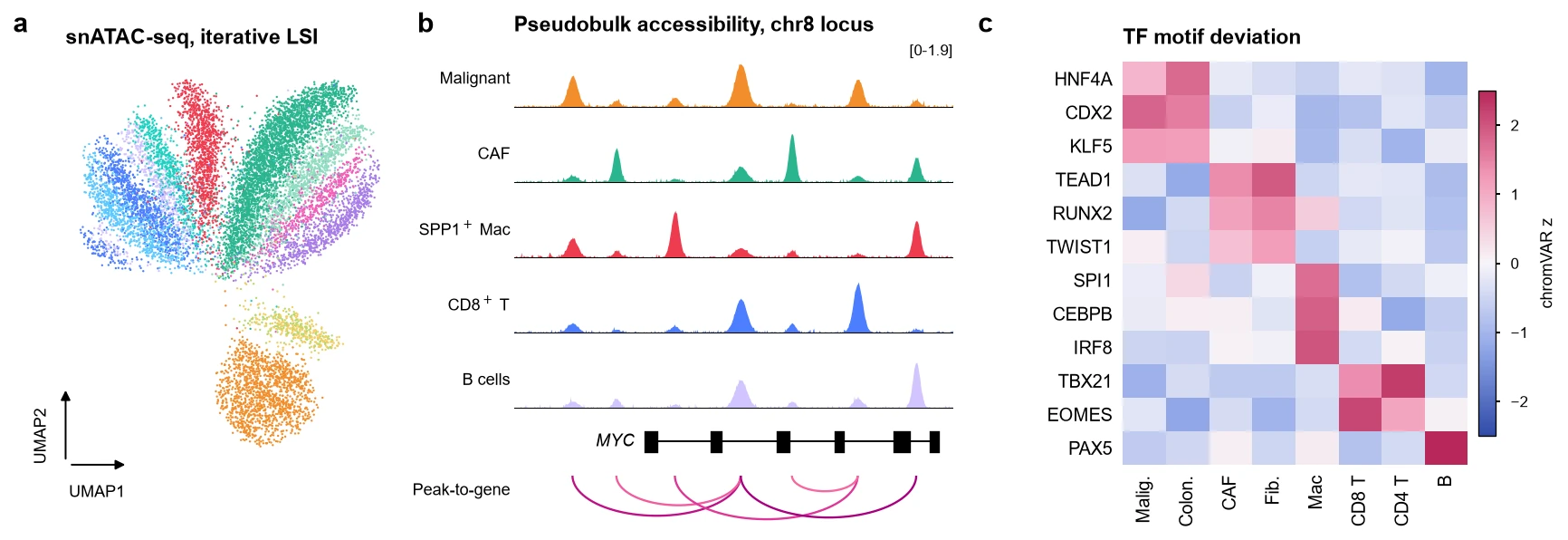
The kind of multi-panel figure we deliver, styled to journal specifications and revised until it is right.
snATAC-seq and scATAC-seq analysis: analyses we run
Every analysis below is available from raw data or from your processed files. Pick the ones your question needs; we recommend a robust core set during scoping.
Fragment-level QC
- Alignment and fragment generation
- Cell Ranger ATAC or chromap, with mitochondrial and duplicate filtering.
- TSS enrichment and nucleosome signal
- Per-cell quality metrics with sample-specific thresholds.
- Fraction of reads in peaks (FRiP)
- Signal-to-noise assessment per sample and per cluster.
- Doublet removal
- ArchR doublet scores, AMULET and scDblFinder for ATAC.
Clustering and annotation
- Iterative LSI and dimensionality reduction
- TF-IDF and LSI with batch-aware integration (Harmony).
- Gene activity scores
- Accessibility-derived gene scores to annotate clusters.
- Label transfer from scRNA-seq
- Canonical correlation or bridge integration with matched or public RNA references.
Regulatory element discovery
- Cell-type-specific peak calling
- MACS2/3 on pseudobulk replicates per cluster, then merged into a reproducible peak set.
- Differential accessibility
- Pseudobulk tests between conditions within each cell type.
- Motif enrichment and chromVAR
- JASPAR/CIS-BP motif deviations to rank driver transcription factors.
- TF footprinting
- Bias-corrected footprints (TOBIAS, ArchR) to support TF binding claims.
- Co-accessibility networks
- Cicero-style links between distal elements and promoters.
Integration and interpretation
- Peak-to-gene linkage
- Correlate accessibility with expression to nominate enhancer-gene pairs.
- GWAS variant enrichment
- LD score regression and fine-mapped variant overlap with cell-type peaks.
- Chromatin trajectories
- Accessibility dynamics along differentiation or treatment time courses.
- Gene regulatory networks
- SCENIC+ and FigR networks combining accessibility and expression.
What you receive
- QC report (TSS enrichment, fragment size distributions, FRiP, doublet calls)
- Reproducible peak set and cell-by-peak matrices
- Normalized bigWig tracks per cell type, ready for IGV or the UCSC browser
- Motif and TF activity results with ranked driver TFs
- Figures and genome browser panels, methods text, and code
Mistakes our experts avoid
- Calling peaks on all cells at onceBulk peak calling hides rare cell-type-specific elements. We call per cell type and merge into an iterative overlap peak set.
- Annotating from gene activity aloneGene scores are noisy for many genes. We confirm identities by label transfer from RNA and by known regulatory elements.
- Treating motif enrichment as bindingA motif tells you which TF family could bind, not which member does. We pair chromVAR with expression and footprints.
- Ignoring Tn5 insertion biasRaw footprints reflect enzyme sequence preference. We use bias-corrected footprinting before drawing conclusions.
- Mismatched genome buildsMixing hg19 and hg38 annotations or peak sets silently ruins overlaps. We standardize builds and annotations from the start.
Tools and methods
We choose methods for your design, benchmark where it matters, and document versions for reproducibility.
- Cell Ranger ATAC
- ArchR
- Signac
- SnapATAC2
- MACS3
- chromVAR
- TOBIAS
- Cicero
- SCENIC+
- FigR
- JASPAR
- HOMER
How a project runs
Scoping call
Thirty minutes, free. We learn the biology, the design and the deadline.
Capped estimate
A written plan with hours, deliverables and a cap. No surprise invoices.
Secure transfer and QC
Encrypted transfer, then a QC report and a go/no-go call within days.
Analysis with check-ins
Weekly calls with your duo team and interim figures you can steer.
Figures, methods, code
Publication-quality figures, methods text and reproducible code. Revisions are unlimited.
Frequently asked questions
What is the difference between scATAC-seq and snATAC-seq?
Both measure chromatin accessibility in individual cells. In practice nearly all droplet protocols work on isolated nuclei (snATAC-seq), which makes them compatible with frozen tissue. The analysis is the same, and we handle both.
Can you integrate my ATAC data with scRNA-seq from different samples?
Yes. When RNA and ATAC come from different cells, we integrate them by label transfer and canonical correlation. When they come from the same cells (10x Multiome), we use paired methods such as WNN, MultiVI or MOFA+.
Which transcription factors drive my cell states?
We rank candidate drivers by combining chromVAR motif deviations, TF expression, footprints and peak-to-gene links. The result is a short, defensible list of candidate drivers rather than hundreds of enriched motifs.
How deep should I sequence snATAC-seq?
We usually recommend at least 25,000 read pairs per nucleus for 10x snATAC-seq. Lower depth works for clustering but limits peak-level differential analysis. We can review your design before you sequence.
Further reading
Send us your snATAC-seq data question.
Send a few lines about your experiment. A bioinformatician and a biologist will review it and reply with questions or a capped estimate. Analysis starts at $79/hour, and figure customization is unlimited.
- Free 30-minute scoping call
- Capped estimate before any billable work
- You own all data, code, figures and IP
Prefer email? contact@omicsquest.com